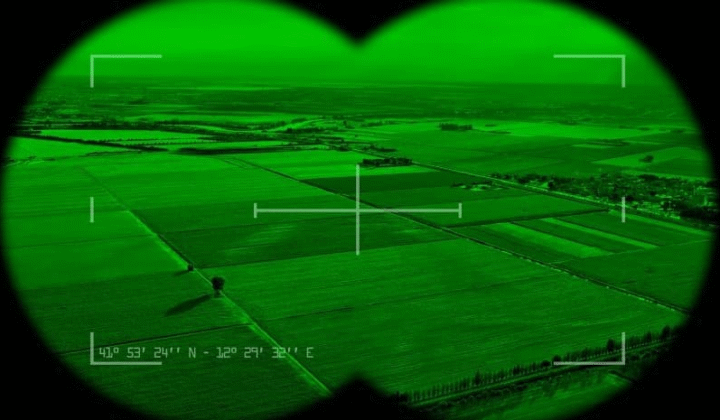
Effective observation and target detection at night, in complete darkness, or in conditions of limited visibility directly determine combat effectiveness and personnel safety. Military personnel use night vision devices and thermal imagers to perform a wide range of tasks, from observing the enemy to navigating in the dark, and in everyday life, they can be used for hunting.
According to research, the global market for night vision devices in the military segment is projected to grow to approximately $7.51 billion by 2029. In addition, among NVD products, the night vision goggles segment holds the leading share in this class of devices. In the thermal imaging segment, the global market could reach $17.6 billion by 2033, with an average annual growth rate of 6.3%. This rapid market growth confirms that both types of devices remain key elements of modern tactical equipment.
The choice between a night vision device and a thermal imager should be based on an understanding of how they work, their tactical purpose, and their characteristics under field conditions.
Principle of Operation of a Night Vision Device
Night vision devices (NVDs) work by amplifying the low-intensity light coming from stars, the moon, or residual artificial lighting. The main element of the system is an image intensifier tube (IIT), which transforms photons of light into electrons, amplifies them, and then converts them back into a visible image. This process enables the operator to observe the terrain even in conditions where the naked eye is virtually ineffective.
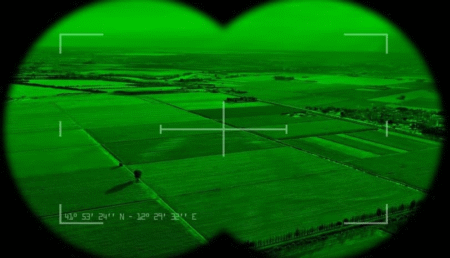
Stages of image formation in a NVD
- Light flux collection. The light entering the equipment lens contains both visible and near-infrared waves. The lens focuses this flux and directs it onto the photocathode, the first element of the IIT.
- Conversion of photons into electrons. The photocathode reacts to light by emitting electrons in proportion to the intensity of the incident radiation. This forms an electronic image of the scene, where bright areas correspond to illuminated areas and dark areas correspond to shaded areas.
- Amplification of the electron flow. The electrons then pass through a multi-channel electron plate, a kind of microamplifier, where each electron generates a cascade of new ones. This is a key stage that amplifies the signal by several orders of magnitude. Thanks to this, even the smallest amount of light is converted into a clear image.
- Formation of a visible image. The stream of amplified electrons hits a phosphor screen, where it is converted back into photons, i.e., visible light. A monochrome image (usually green) is formed on this screen, which the user sees through the eyepiece.
In the complete absence of natural light, a night vision device can use built-in or external infrared illumination. Such illumination is invisible to the naked eye but can be easily detected by any other night vision device or thermal imager, which creates a risk of exposure. For this reason, in combat conditions IR illumination is used only locally and for short durations.
Generations of night vision devices
Modern night vision devices are classified by generations of the IIT:
Generation I – basic systems with moderate amplification, sensitive to ambient lighting.
Generation II – feature an improved image intensifier tube, providing stable amplification and better resolution.
Generation III – use gallium arsenide photocathodes, allowing them to work effectively even in starlight.
Generation IV (or filmless/auto-gated) – the microfilm layer has been removed, improving performance under dynamic lighting changes (flashes, tracers, explosions).
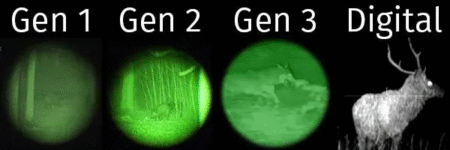
Night vision devices do not perceive colors, but they allow you to clearly distinguish contours, landmarks, and objects. Estimating distance also requires skill, as the image seen by the operator is enhanced but remains two-dimensional. Due to their low power consumption and high resolution, night vision devices remain indispensable for observation, orientation, movement, and aimed fire at night.
Principle of operation of a thermal imager
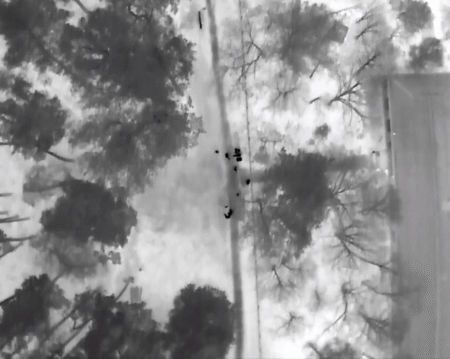
A thermal imager is an optoelectronic device that creates images of objects using infrared radiation, which is invisible to the human eye. Unlike night vision devices, a thermal imager does not require any external lighting – it works based on the temperature difference between objects and the surrounding environment, so it can be used to observe objects in complete darkness, as well as in conditions of smoke, fog, dust, or camouflage.
Any body with a temperature above absolute zero (-273.15 °C) emits infrared energy. The intensity of this radiation is directly proportional to the surface temperature. A thermal imager detects this heat in the wavelength range of approximately 3 to 14 micrometers, converts it into an electrical signal, and then into a visible thermographic image.
Main components of a thermal imager
- Infrared lens. Special optics made of germanium or zinc selenide transmit IR rays and focus them on the receiving element.
- Matrix. Converts thermal radiation into an electrical signal.
- Electronic signal processing unit. The received signal is digitally processed – the system generates a thermal map of the scene, where each pixel corresponds to a specific temperature. Calibration, noise filtering, and contrast enhancement algorithms are applied to optimize image quality.
- Display or viewfinder. The processed image is displayed on the screen in pseudocolor format (so-called palettes – white hot, black hot, rainbow, etc.), which facilitates the interpretation of temperature differences.
A thermal imager is a universal tool for observing objects, searching for and identifying targets, capable of providing a tactical advantage even in challenging weather conditions and complete darkness. Its main strength is detection where the human eye cannot see anything. A thermal imager is completely independent of external lighting and can be used day and night without reducing its effectiveness.
What is better to choose: a thermal imager or a night vision device?
The choice between a night vision device and a thermal imager directly depends on the tactical situation, the nature of the tasks, and the environmental conditions in which the unit operates. Both types of equipment serve different purposes, so their effectiveness is determined not by their technical specifications alone, but by how effectively they are integrated into the overall surveillance and target acquisition system.
When is it advisable to use a thermal imager?
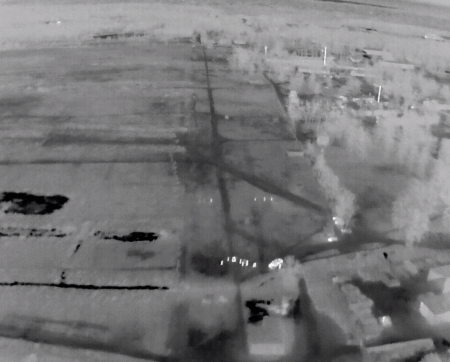
A thermal imager is indispensable for detecting enemies, especially in conditions of limited visibility or active camouflage. It detects thermal contrasts – such as personnel, running engines, or traces of recent human or vehicle activity.
A thermal imager is useful for:
- night observation and reconnaissance;
- monitoring the perimeter or sectors of possible enemy approach;
- operations in smoke or fog, where night vision devices lose their effectiveness;
- searching for wounded personnel or recently operated equipment;
- target designation and fire correction in the dark.
Its main advantage is the ability to see thermal signatures regardless of lighting or weather conditions. However, target identification may sometimes require additional observation tools due to the lower level of image detail.
When is it more effective to use night vision devices?
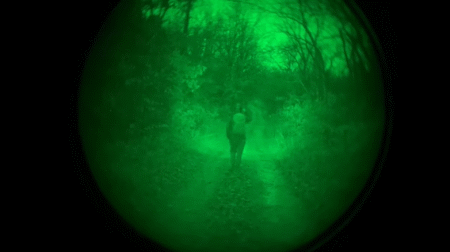
Night vision devices, on the other hand, provide high image detail, which is important for orientation, covert movement, and close-range situational observation.
Night vision devices are optimal in situations where it is necessary to:
- move in the dark without using light;
- engage targets accurately or adjust fire;
- observe the actions of a unit or coordinate movement;
- perform tasks in conditions of moderate natural lighting (starry or moonlit sky).
Night vision devices are convenient for dynamic actions and provide a natural perception of space, but they are completely dependent on the level of illumination. Using IR illumination can reveal the operator to an enemy equipped with thermal imaging equipment.
Conditions under which thermal imagers or NVDs don’t work
Despite the high capabilities of modern optical systems, there are situations when neither night vision devices nor thermal imagers provide effective observation. Such conditions arise when the physical principles on which the equipment is based are violated or lose their meaning due to the characteristics of the environment.
- Neither device can see through solid objects such as soil, concrete, metal, dense cover, or thick layers of rock. Night vision devices do not transmit light, so they cannot show objects behind obstacles. Thermal imaging devices also do not detect heat through glass or solid materials that completely block infrared radiation. In such cases, the effectiveness of the equipment is reduced to zero – the target must be in the direct line of sight.
- Sudden changes in ambient temperature. The absence of temperature contrast is critical for thermal imagers. If surrounding objects have the same temperature – for example, after heating from the sun or in conditions of intense heat – the difference between the human body and the background is minimal. In such a situation, the thermal imager is blinded, the image becomes low-contrast, and it is difficult to distinguish the target from the terrain. These conditions are not critical for night vision devices, but excessive daylight or strong artificial lighting can overload the image intensifier tube.
- Severe atmospheric phenomena. Thick smoke, snowfall, heavy rain, dense fog, or dust storms scatter and absorb both visible light and infrared radiation. The PNB is blinded by the reflection of light by particles in the air, and the thermal imager can perceive the thermal noise of the environment as continuous interference. Warm fog or smoke, whose temperature is close to that of the human body, is particularly problematic – in such cases, thermal imagers struggle to distinguish targets.
- Explosions, flashes, and tracers can cause image intensifier overload in night vision devices, requiring time to restore normal operation, and matrix oversaturation in thermal imagers due to sudden temperature spikes in the field of view. After a bright flash or explosion, the operator must recalibrate the device or temporarily shift the observation sector.
- Powerful sources of electromagnetic radiation or radio interference can cause false signals, artifacts, or image distortion in both systems, and the difference between objects and the surrounding environment may be minimal. This is especially true near high-voltage lines, radars, or power plants.
Key solutions for tactical unit equipment
In modern defense and tactical structures, night‑vision and thermal‑imaging equipment is becoming increasingly critical. It is actively implemented in units at various levels, from reconnaissance and assault groups to armored vehicle crews and drone operators. The choice between them depends on the tactical task, terrain conditions, and time of day in which the soldier operates. If the unit's task is searching, observation, and detection, a thermal imager is the priority. If the main goal is movement, orientation, and precision fire, a night vision device should be chosen.
In practice, the best results are achieved by combining both types of equipment. Thermal imaging is used for initial target detection, while night vision is used to clarify the situation and perform actions accurately. Many modern optical devices feature hybrid systems – combined sights and binoculars, where thermal and optical channels work in parallel. This allows you to quickly identify targets while maintaining situational awareness even in difficult conditions.
Any of these devices can be a critically important tool, so a competent commander strives to have at least one thermal imager in the group to detect threats in a timely manner, and night vision devices to ensure orientation and movement. The one who acts first is the one who sees first, and in modern warfare, this is what determines the outcome.