The emergence of thermal FPV drones and reconnaissance UAVs has fundamentally changed the rules of survival on the battlefield. Multispectral camouflage is no longer specialized equipment for selected units; it has become one of the essential elements of individual soldier protection.
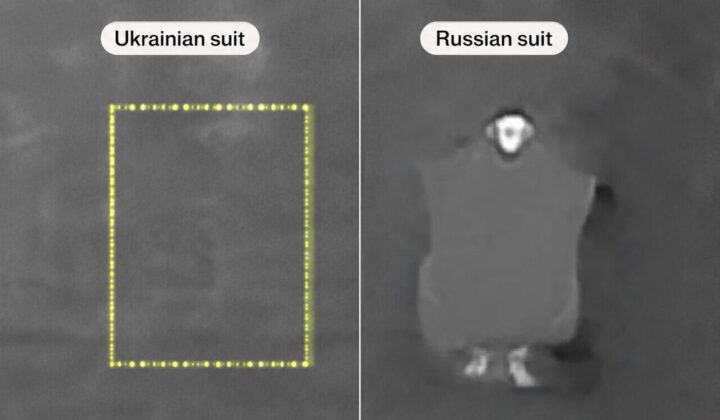
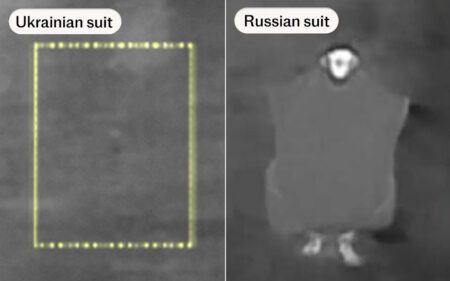
Recent reports in Western media have drawn attention to another illustrative example. Russian forces have begun using so-called anti-drone cloaks, or “invisibility cloaks,” on a large scale. These cloaks are intended to conceal personnel from the thermal imaging cameras carried by Ukrainian drones. In practice, however, the effect has often been the opposite: instead of concealing the wearer, they frequently make the target easier to detect.
The problem is not the concept, but its implementation
A thermal imager does not see a person directly – it detects the temperature difference between an object and its surrounding environment. That is why effective camouflage must do more than simply shield heat; it must manage thermal radiation in a way that minimizes the temperature contrast.
Low-cost or technologically simplified solutions operate on a different principle. They merely block part of the body's thermal radiation but do not provide control over the temperature of the material's outer surface. As a result, an unnatural spot appears in the thermal image, with a temperature that differs significantly from that of the surrounding ground, vegetation, or other objects.
This effect becomes particularly noticeable during transitional periods of the day, when the ground surface is heating up or cooling down rapidly. If the temperature of the cloak's outer surface does not change in sync with the surrounding environment, the UAV operator sees a high-contrast anomaly that often attracts attention even more readily than the silhouette of an unprotected person. This is precisely the mechanism described by military experts when analyzing the use of Russian anti-drone cloaks.
Thermal signature is more than body temperature
A common misconception is that infrared camouflage is simply about retaining body heat. In reality, modern thermal imaging sensors analyze a much more complex picture.
A soldier's detectability is influenced by:
- the temperature of the outer surface of the equipment;
- the emissivity of the material;
- the rate of heat exchange with the surrounding environment;
- the shape of the person's thermal profile;
- changes in the thermal signature during movement;
- weather conditions, wind, solar radiation, and humidity.
That is why professional multispectral camouflage is the result of engineering work involving materials, fabric structure, and the physics of heat transfer – not simply the use of a thermal insulation layer.
Multispectral camouflage must perform across multiple spectral bands
Modern UAVs rarely rely on a single observation channel. Most reconnaissance drones are equipped with a combination of a daylight optical camera and a thermal imager, while specialized systems may also employ near-infrared (NIR) and short-wave infrared (SWIR) sensors. This means that concealment in only one spectral band no longer guarantees survival.
That is why modern armed forces are moving beyond the concept of a “thermal cloak” toward comprehensive multispectral camouflage. Its purpose is to simultaneously reduce detectability in the visible spectrum, the near-infrared (NIR) and short-wave infrared (SWIR) bands, as well as the mid-wave infrared (MWIR) and long-wave infrared (LWIR) bands, where most military thermal imaging systems operate.
This approach is already reflected in the requirements of leading armed forces worldwide. For example, the US Marine Corps Multispectral Camouflage Overgarment (MCO) program defines requirements for reducing detectability across multiple spectral bands and establishes specific non-detection thresholds based on the type of sensor, its location, and the distance to the target.
Why laboratory specifications are insufficient
Even a material with good thermal insulation properties will not necessarily perform effectively under battlefield conditions.
The real battlefield is constantly changing. Solar radiation, wind, rain, the soldier's physical activity, and contact with the ground or military equipment continuously affect a person's thermal signature. If a material is unable to adapt to these changes, it quickly becomes a source of a high-contrast thermal anomaly.
That is why professional multispectral camouflage systems undergo not only laboratory testing but also extensive field trials conducted at different times of the day, under varying weather conditions, and at different observation distances. Only such testing makes it possible to assess the actual probability of detection by a thermal imaging operator or a UAV.
Of particular importance today is the assessment of the Probability of Detection (PoD). Unlike the subjective evaluation of thermal images, this metric makes it possible to quantify how effectively a particular camouflage system complicates detection by an operator or by automated target detection algorithms.
Comprehensive signature reduction as a requirement of modern warfare
The case of the Russian anti-drone cloaks once again confirms the fundamental principle of modern camouflage: concealing heat alone is not enough – what matters is managing the thermal signature.
The realities of modern warfare require a shift from simple thermal insulation products to professionally engineered multispectral systems capable of reducing the probability of detection across multiple spectral bands while maintaining their effectiveness under real battlefield conditions. This approach is now shaping the development of personal camouflage technologies in the world's leading armed forces and is playing an increasingly important role in the survivability of military personnel in combat zones.